
How Voice Can Impact Gender Expression in Social and Professional Settings
Voice is one of the most immediate and revealing aspects of human identity. Before a name is given, before a pronoun is confirmed, before any visual cue registers — a voice speaks. It conveys warmth or authority, familiarity or distance, and in many social and professional contexts, it implicitly communicates something about the speaker’s gender. For transgender, non-binary, and gender-diverse individuals, this reality carries significant weight. The voice that others hear may not reflect the gender identity that feels authentic — and that gap can affect everything from first impressions in a job interview to the ease of daily interactions with strangers.
Gender-affirming voice therapy is a specialized branch of speech-language pathology that helps individuals align their voice with their gender identity. At Speech Therapy Centres, with locations serving Aurora, Newmarket, Markham, Thornhill, the GTA, Mississauga, Brampton, Burlington, Ajax, Oshawa, Pickering, and Ottawa, we support gender-diverse individuals at every step of their voice journey — online and in person.
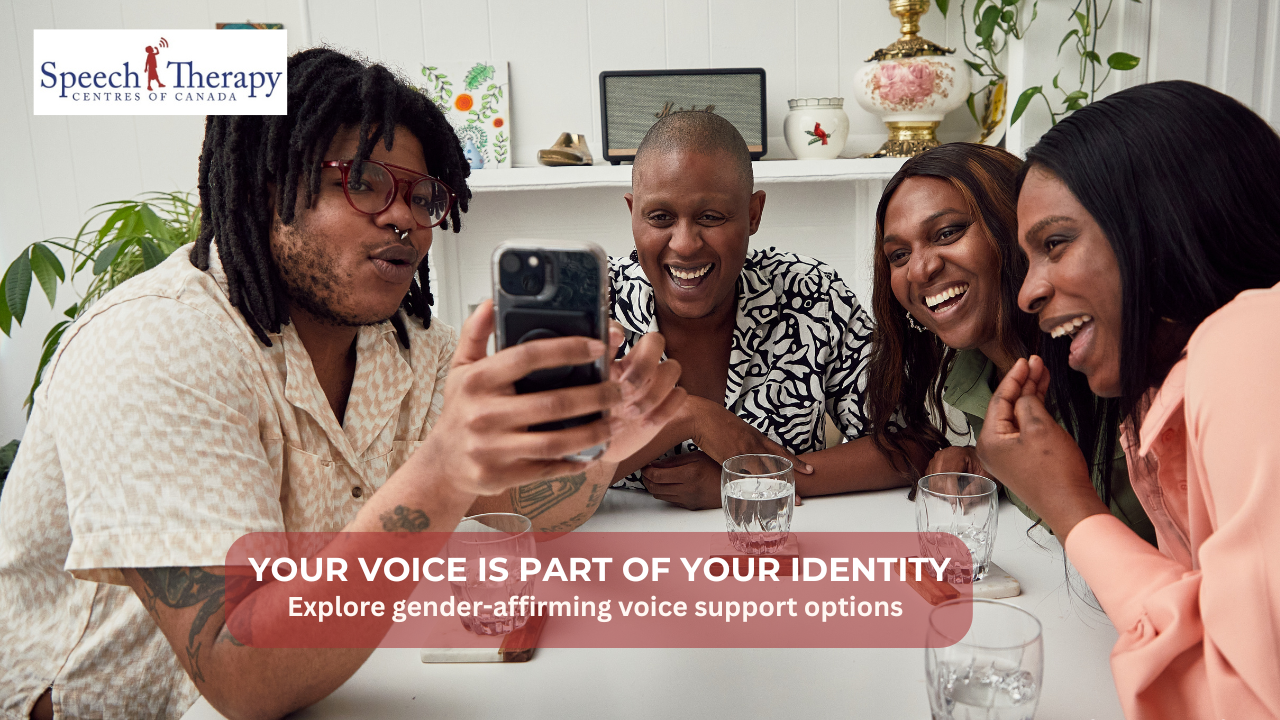
The Role of Voice in How We Are Perceived and How We Feel
Research in psycholinguistics and social perception consistently demonstrates that voice characteristics influence gender attribution within milliseconds of hearing a speaker. Pitch, resonance, intonation patterns, articulation, and speech rhythm all contribute to how a listener categorises a speaker’s gender — often unconsciously and automatically. For many gender-diverse individuals, being misgendered based on voice alone is a frequent, exhausting, and emotionally significant experience that affects psychological well-being, social confidence, and professional performance.
The impact surfaces in everyday interactions: answering a phone call, placing a coffee order, speaking in a meeting, or being introduced at a networking event. In professional settings, particularly in Toronto, Ottawa, Mississauga, or any of the communities we serve, the cognitive load of anticipating misgendering, deciding whether to correct it, and managing the emotional aftermath can divert energy and attention from work performance and workplace engagement.
A study published in the American Journal of Speech-Language Pathology found that gender-affirming voice training significantly improved self-reported quality of life, communication confidence, and social participation among transgender women, with benefits extending to both personal and professional domains of daily life.
What Speech Therapy for Gender-Affirming Voice Actually Involves
Gender-affirming voice therapy is a collaborative, individualised process led by a registered speech-language pathologist with specialised training in voice and gender. It is not simply about raising or lowering pitch. Effective gender-affirming voice therapy addresses the full acoustic and behavioural profile of the voice, including:
- Pitch and pitch range: The fundamental frequency of the voice and how it varies across different communicative contexts — speaking versus laughing, statement versus question, formal versus casual register.
- Resonance: Where in the vocal tract the voice is amplified and shaped, chest resonance tends to be associated with masculine voice quality, while forward oral and head resonance is associated with feminine voice quality. Resonance training can be more impactful than pitch modification for overall gender perception.
- Intonation and prosody: The melodic patterns of speech, the rises and falls in pitch across sentences and phrases ,carry significant gender cues and vary meaningfully across gender-typical speech communities.
- Articulation and vocal quality: Consonant precision, vowel shaping, breathiness, and vocal tension all contribute to the overall gender impression of a voice and are addressable through targeted speech therapy techniques.
- Nonverbal communication patterns: Laughter, filler sounds, pacing, and turn-taking behaviours all intersect with gender expression and can be explored as part of a comprehensive voice and communication program.
Voice in Professional Settings: Why It Matters for Career and Workplace Wellbeing
The professional environment presents some of the most consistent and consequential voice challenges for gender-diverse individuals. Job interviews, client presentations, team meetings, phone calls, and conference participation all place the voice in highly visible, evaluative contexts where the cost of misgendering or of constantly monitoring and modulating one’s voice under stress can be professionally and emotionally significant.
Workplace research consistently links authentic self-expression with improved engagement, productivity, and job satisfaction. When voice becomes a source of anxiety rather than a natural extension of identity, that authenticity gap has real professional consequences. It can lead to over-rehearsed, stilted communication that limits professional presence, or to avoidance behaviours, such as choosing email over the phone, declining speaking opportunities, or minimising participation in group discussions, which constrain career development.
Gender-affirming voice therapy directly addresses this dynamic by building a voice that is both authentic and versatile, one that can carry confidence and natural variation across the full range of professional communication demands, without requiring constant conscious effort to maintain.
Voice in Social Settings: Connection, Confidence, and Community
Social interactions are where voice and identity intersect most personally. A phone call with a parent, a conversation with a new acquaintance, a dinner with friends, or an encounter with a service provider all involve the voice performing consciously or not, a version of gender that may or may not align with inner experience.
Participants in gender-affirming voice therapy frequently describe a gradual but profound shift in social confidence as their voice becomes more congruent with their identity. Interactions that previously required vigilance become more spontaneous. Social settings that felt threatening become more accessible. The voice, once a source of dysphoria or anxiety, becomes a vehicle for authentic self-expression and for the ease of connection that comes when identity does not need to be defended or explained.
The Speech-Language & Audiology Canada (SAC-OAC) recognises gender-affirming voice and communication therapy as an evidence-based practice area within speech-language pathology, noting that it supports not only voice modification but the broader communicative well-being and quality of life of gender-diverse individuals across Canada.
What to Expect from a Gender-Affirming Voice Therapy Program
A typical gender-affirming voice therapy program begins with a comprehensive voice assessment, during which the speech-language pathologist evaluates current vocal characteristics, discusses the individual’s goals and preferences, and establishes baseline measurements. From there, a personalised program is designed, drawing on evidence-based techniques for resonance modification, pitch training, prosody shaping, and communication style with a realistic timeline and clear milestones.
Most individuals attend weekly or biweekly sessions and are given home practice exercises to reinforce gains between appointments. Many clients report noticeable changes in voice quality and social confidence within six to twelve weeks of consistent practice.
For those seeking additional guidance on the evidence base for gender-affirming care, the World Professional Association for Transgender Health (WPATH) publishes internationally recognised standards of care that include voice and communication therapy as a core component of gender-affirming healthcare.
Voice Therapy Services Across the GTA and Ontario
Speech Therapy Centres offers a comprehensive range of voice and communication services for gender-diverse individuals across Ontario. Our gender-affirming voice therapy program is available both in-person and virtually, serving clients in Aurora and Newmarket, Markham and Thornhill, Mississauga and Brampton, Burlington and Ajax, Oshawa and Pickering, and Ottawa. Whether you are seeking voice feminisation, voice masculinization, or a gender-neutral voice profile, our registered speech-language pathologists provide personalised, affirming care tailored to your goals. Visit our voice therapy page to learn more about our services and how to get started.
Ready to Find Your Voice? Connect with Speech Therapy Centres Across Ontario
Your voice is one of the most personal expressions of who you are. You deserve one that feels like yours. At Speech Therapy Centres, our registered speech-language pathologists provide compassionate, evidence-based gender-affirming voice therapy tailored to your individual goals, communication style, and life context. Whether you are at the beginning of your voice journey or looking to refine and consolidate your progress, we are here to support you every step of the way.
With in-person clinics in Aurora, Newmarket, Markham, Thornhill, Mississauga, Brampton, Burlington, Ajax, Oshawa, Pickering, and Ottawa, plus virtual appointments available province-wide, expert gender-affirming voice therapy is accessible no matter where you are in Ontario.
Your voice, your way. Book a consultation or learn more at speechtherapycentres.com/voice-therapy — and take the first step toward a voice that truly reflects you.


